BLOG
How state and local governments can prepare for AI


State and local governments are already putting artificial intelligence to work. The next step is building the policies, skills, data practices, and organizational ownership that help agencies use it responsibly and produce measurable results.
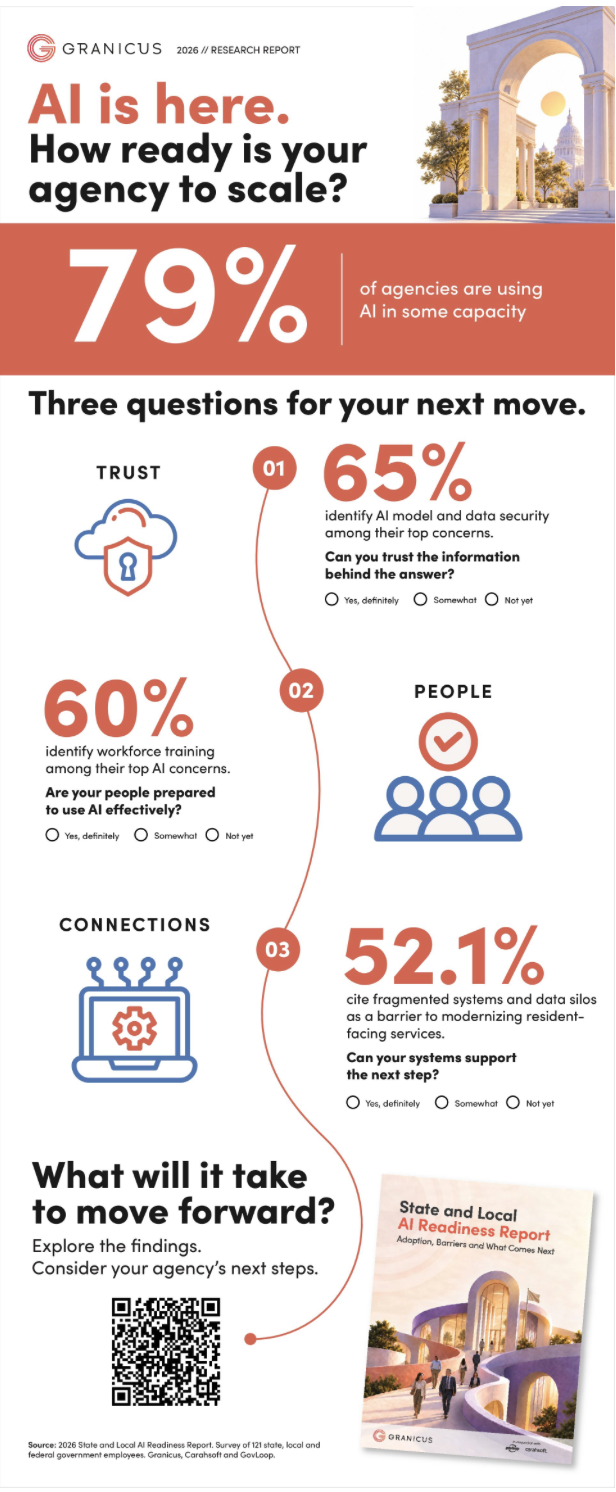
New Granicus research shows how much of that foundation remains under development. Among 367 government respondents who answered questions about AI use in a recent survey, 46% said their organization was already using the technology. Workforce preparation and policy awareness tell a different part of the story. Nearly one-third reported no significant AI literacy or training effort, and another 30% said training reached only a few roles.
The “State and local AI readiness” report examines this gap between adoption and organizational preparation. Its findings give government leaders a way to assess where AI can support their work and which foundations need attention before an experiment becomes an operating capability.
AI use in government already extends across communications, administration, research, and program work. Among respondents whose organizations use AI, 60% reported using it for content creation and 59% for research. Among respondents whose organizations had yet to adopt AI, 56% identified data analysis as a potential use.
These activities show where employees see immediate value. Research, document review, content development, and data analysis all require significant staff time. AI can support portions of that work when an agency defines the task, identifies suitable information, assigns human review, and establishes a way to judge the result.
That discipline helps leaders separate an interesting demonstration from a useful application. A viable use case begins with a specific operational need. The agency then determines who owns the process, which data the tool can use, what review the output requires, and what outcome the work should produce.
Consider document summarization. The objective might be to help employees review a large volume of material within an existing workflow. The agency would still need to establish which documents can enter the system, who checks the summary, how errors are handled, and whether the process saves time without omitting essential information.
Government employees need enough AI literacy to understand how their choices affect accuracy, security, accessibility, and public accountability. Product instruction covers only one part of that need.
The survey indicates that many agencies are early in this work. While 32% of respondents reported no significant AI literacy or training effort, 30% described training as limited to a few roles. Only 3% characterized their workforce as highly AI literate.
Effective preparation should reflect how employees encounter AI in their jobs. Staff members entering information into a tool need guidance on approved data use. Employees reviewing generated material need methods for checking accuracy, accessibility, and bias. Managers need enough fluency to select suitable uses, assign oversight, and recognize when an application carries greater risk.
This work also requires continued reinforcement. Agencies will learn from early uses, identify new risks, and refine their expectations. Training, policy, and process should develop together so employees receive guidance they can apply to actual work.
The strongest expectations for AI center on time and workload. In the survey, 67% of respondents expected AI to help with repetitive tasks, while 66% expected it to save time. Smaller shares expected it to reduce staff demands or staffing needs.
Agencies can begin with work that consumes substantial time, follows a defined process, and allows employees to review the result before it affects the public. Examples may include summarizing documents, organizing internal knowledge, supporting research, or developing an initial content draft.
Use cases that shape eligibility decisions, legal interpretations, emergency communications, or other consequential services require deeper scrutiny. Leaders need to consider the quality of the underlying data, the consequences of an error, the review authority assigned to employees, and the options available to a resident who receives an incorrect result.
The goal of each use case should be explicit. An agency might seek to reduce processing time, improve consistency, help employees locate information, or give staff additional capacity for direct service. A defined objective allows the organization to measure what changed and decide whether the use should continue.
Policies establish the boundaries for AI use, but employees must also be able to find and apply them. Among survey respondents, 43.1% said their organization had developed AI policies. Another 27.5% said it had not, while 29.4% did not know.
That level of uncertainty can leave employees without reliable guidance during everyday decisions. A staff member may need to know whether a document contains restricted information, which tools have been approved, who can authorize a new use, or how generated material should be reviewed. A policy becomes operational when it answers those questions within the flow of work.
Governance also creates a shared process for evaluating proposed uses. Legal, privacy, security, accessibility, records management, procurement, technology, and program leaders may each hold part of the required expertise. Defined ownership helps those teams address relevant concerns early and gives employees a known path for review.
Public accountability belongs in this structure as well. Agencies should be prepared to explain how AI influences a service, how information is protected, how employees review results, and what recourse exists when an output is wrong.
Agencies will pursue AI at different speeds and for different purposes. A consistent readiness assessment can help each organization make decisions grounded in its own responsibilities, workforce, data, and services.
Before launching a use case, leaders should be able to identify:
Unresolved questions reveal where additional work is needed. The agency may need to strengthen policy, prepare data, redesign a process, train employees, or assign ownership before introducing another tool.
AI readiness grows through those decisions. Agencies that connect each use case to a real need, prepare employees for their responsibilities, and measure the result will be equipped to turn early adoption into dependable public service.
Download “State and local AI State and local AI readiness” to review the adoption data, examine common barriers, and identify the organizational foundations that can support responsible AI use.