AI for public sector
Practical guidance for how agencies adopt and scale AI with governance, accuracy, and security built in.


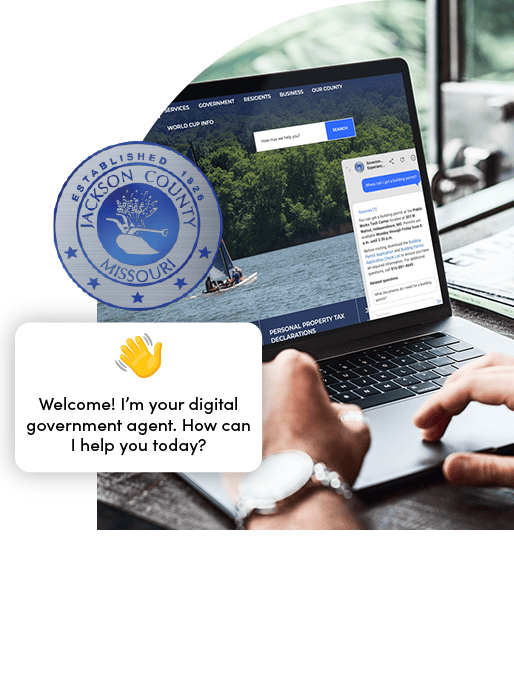
Granicus helps agencies apply AI where it matters most — at the point where people interact directly with government and when work must move through real, governed operations. While the specifics differ across sectors, the challenge is the same: high demand, fragmented systems, and rising expectations. Granicus ensures AI improves service outcomes without sacrificing accountability, trust, or control.
Local governments face high volumes of everyday requests that are often incomplete, duplicated, or misrouted, creating delays, rework, and resident frustration. With the right solution in place, agencies resolve common issues faster, have fewer backlogs, reduce staff workload, and deliver more reliable services that build resident trust.
Complex benefits, licensing, and regulatory programs make it difficult for constituents to understand eligibility and next steps, driving confusion and call volume. With the right solution in place, agencies have clearer paths through services, cleaner eligibility intake, reduced inquiry volume, and more consistent outcomes across agencies.
Federal agencies must deliver consistent guidance and outcomes at national scale — while meeting strict requirements for transparency, policy alignment, and defensibility. With the right solution in place, agencies get more consistent, policy-aligned guidance, improved eligibility clarity, and scalable case handling with built-in accountability.
Patients often struggle to navigate services while staff contend with incomplete intake and misdirected requests that delay care. With the right solution in place, agencies have faster routing to the right care, cleaner intake data, reduced administrative burden, and improved access to services.
Agencies must quickly triage non-emergency issues without overwhelming staff or diverting resources from critical response. With the right solution in place, agencies have quicker, more accurate triage, reduced noise in reporting, and clearer
Visitors expect easy, multilingual access to information while staff are stretched answering repetitive questions across channels. With the right solution in place, agencies can provide easier access to services for all visitors, reduce staff effort on routine inquiries, and improve visitor experience and sentiment.
Transit agencies manage information spread across PDFs, websites, reports, and third-party systems that are hard for riders to navigate. With the right solution in place, agencies can provide easier access to accurate information, receive fewer inbound calls, improve
Data is key to how large language models (LLMs) and other machine learning capabilities operate. But those models are informed by open-source and commercial data from across the internet.
Public sector AI solutions must reflect how governments engage with the entire community. Unlike commercial tools that center on consumer behavior, government AI must encompass the range of interactions of citizens, residents, business owners, and visitors — spanning public safety, health, transportation, education, and more. By focusing on government specific content, these technologies can help identify gaps, improve responsiveness, and enable more efficient, effective services.
At Granicus, we are not just building technology; we are partnering with governments around the world to implement AI/ML solutions that improve service outcomes, increase community engagement, and strengthen operational efficiency without compromising governance, privacy, or public trust. In doing so, we are proving that technology, when guided by a human-centric vision, can be a force for meaningful and lasting change.
Government teams can redirect their energies toward more complex and strategic initiatives by leveraging AI to manage routine inquiries and citizen engagements.
Ensure solutions prioritize accessibility and simplicity for all users regardless of technical expertise.
Maintain clear, ethical AI usage and decision-making processes to build trust with public stakeholders.
Implement rigorous measures to safeguard data and comply with all regulatory standards.
Focus on delivering actionable guidance that directly improves government efficiency and public service outcomes.
Build systems that can scale across jurisdictions and evolve with changing technologies and policies.
Ensure seamless integration with existing government systems to enhance collaboration and data sharing.
Avoid bias in models and engage stakeholders to ensure AI-driven recommendations match the communities they represent.
We support this doctrine through multiple AI/ML Customer Advisory Boards; the establishment of our AI Governance Board to oversee all our research and technology investments; and clear, public documentation of all our AI practices. These measures are to ensure responsible and ethical development, deployment, and use of AI systems in alignment with public sector values, regulatory requirements, and stakeholder interests.
|
|
|
We don’t design AI in isolation. We work directly with agencies to deploy early, incorporate real feedback, and solve real problems — continually learning what works, where efficiency can be gained, and how services can improve.
Granicus works hand-in-hand with thousands of public sector leaders every day, giving us a deep understanding of the real operational challenges government faces and how to solve them responsibly.
This partnership matters more than ever as AI becomes essential to service delivery. We are entering a new era of AI co-development, building and evolving our AI and machine learning solutions alongside customers through close collaboration, forward deployment, and hands-on support.
Together, we help governments shape AI that is practical, trusted, and ready to scale in the real world.We don’t design AI in isolation. We work directly with agencies to deploy early, incorporate real feedback, and solve real problems — continually learning what works, where efficiency can be gained, and how services can improve.