BLOG
Accessibility maturity matters more than compliance


Government agencies across the country are investing significant time and resources into accessibility audits, document remediation, website improvements, and compliance planning. Yet many teams find themselves chasing accessibility issues instead of building operational practices that prevent those issues from occurring in the first place. Understanding where your organization is on that journey — and what capabilities need to come next — can help you focus resources, reduce risk, and build a more sustainable accessibility program. That’s the purpose of the Accessibility Maturity Model.
If you’ve been working on digital accessibility over the past few years, you’ve probably had some version of the same conversation more than once. Maybe you’re trying to understand the scope of your PDF inventory. Maybe you’re reviewing audit findings. Maybe you’re working with multiple departments to determine who owns what. Or maybe you’re simply trying to figure out where to start.
Those are all reasonable challenges. Accessibility work can feel overwhelming, especially when you’re looking at years of accumulated content, growing public expectations, and an ever-approaching compliance deadline.
What I’ve learned from working with government teams is that the agencies making the most meaningful progress are not necessarily the ones fixing the most issues the fastest. They’re the ones building the organizational habits, ownership models, and workflows that allow accessibility to become part of how they operate every day.
That’s why our team at Granicus developed the Accessibility Maturity Model.
This isn’t intended to be a scorecard or a way to judge where agencies are today. It’s a practical framework for understanding how accessibility programs typically evolve and what steps help move them forward. The goal isn’t perfection. The goal is building a sustainable approach to accessibility that continues working.
One of the most common misconceptions about accessibility is that it can be fully addressed through a single project.
An agency completes an audit, fixes the findings, remediates a collection of PDFs, launches a redesigned website, or adopts a new tool. Those are all important activities, and they often represent significant progress. But accessibility does not remain static after those efforts are complete.
Websites change. Documents are published. Forms are updated. New services are launched. Staff responsibilities shift. Every one of those activities creates potential for new accessibility issues to emerge.
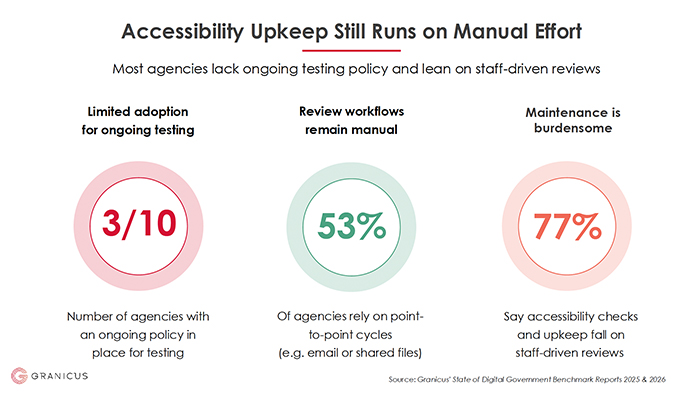
That’s why accessibility increasingly resembles other ongoing organizational responsibilities like cybersecurity. It requires visibility, accountability, monitoring, training, and governance. It requires a practice, not just a project.
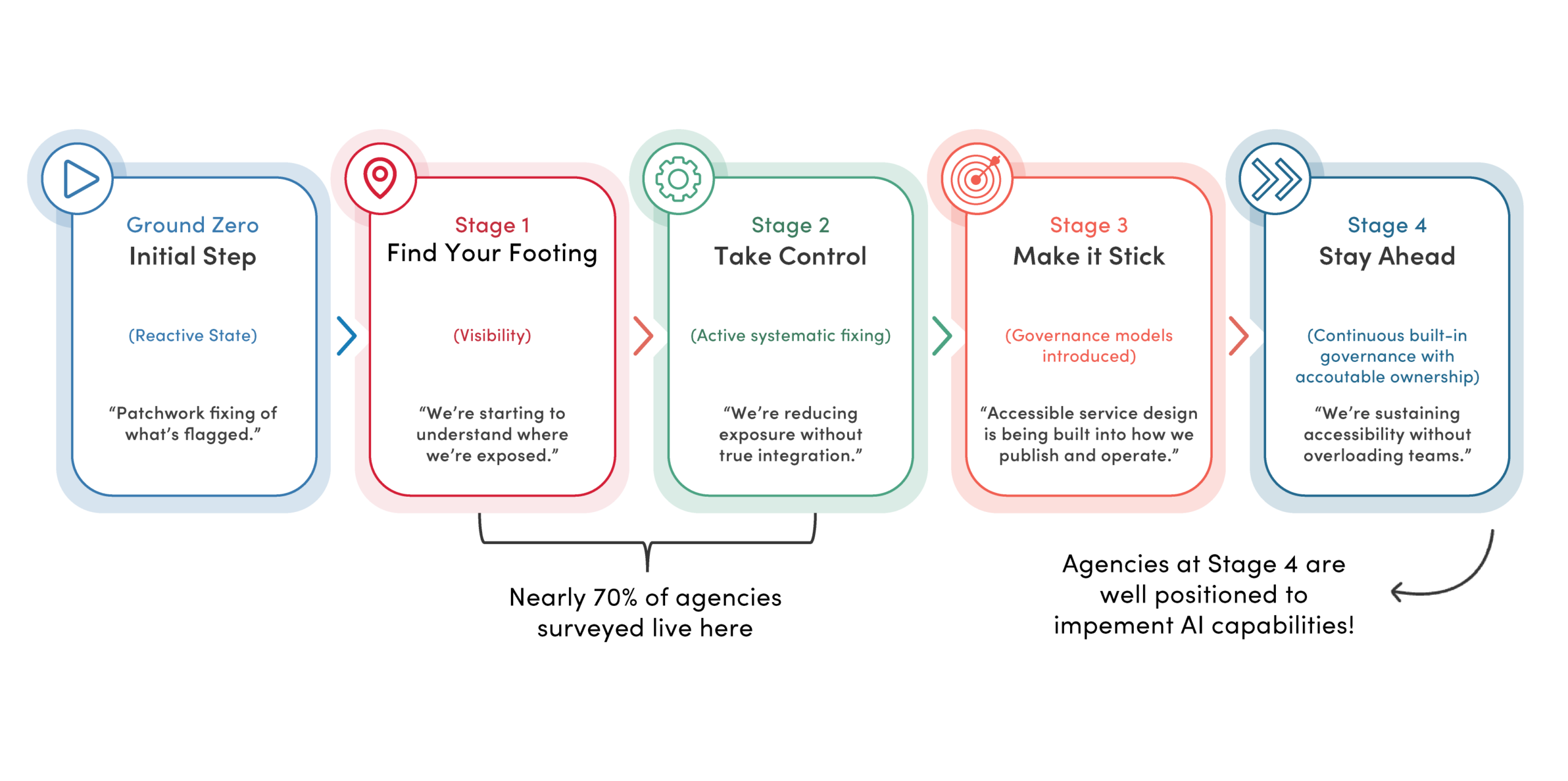
“Patchwork fixing of what’s flagged”
At this stage, accessibility work is driven largely by complaints, audit findings, legal concerns, remediation projects, or looming deadlines. Ownership is often fragmented across departments, and teams are working hard to address issues as they are discovered. Large collections of PDFs, legacy content, and aging digital services can make the challenge feel even larger.
This is where many agencies find themselves today, and there is nothing unusual about that.
The most important objective at this stage is gaining visibility. Before you can prioritize work or establish ownership, you need a clearer understanding of where accessibility risks exist across your digital services, content, and documents.
“We’re starting to understand where we’re exposed”
Agencies move into a discovery phase as they begin assessing websites, inventories, documents, forms, and digital assets.
This is where organizations start building a clearer picture of their accessibility posture. Scans, audits, reporting tools, and dashboards provide important information about where issues exist and which areas may create the greatest risk. Visibility improves significantly. Teams can begin prioritizing efforts instead of reacting to individual findings one at a time.
At the same time, many agencies discover that knowing where issues exist doesn’t necessarily prevent those same issues from returning. Findings can accumulate faster than they are resolved when accessibility isn’t connected to publishing workflows, governance processes, and day-to-day operational practices.
This stage is less about fixing everything immediately and more about creating clarity around what needs attention first.
“We’re reducing exposure without true integration”
The next stage begins when organizations move beyond identifying problems and start systematically addressing them.
Accessibility work becomes more structured. Agencies begin assigning ownership, establishing standards, creating remediation plans, categorizing risk, and developing processes for managing accessibility work over time. Teams often start replacing inaccessible content formats, reevaluating content publishing practices, and building more repeatable approaches to remediation.
This is often where organizations experience their first meaningful reduction in risk.
At the same time, accessibility may still feel like a specialized initiative rather than an organization-wide capability. Progress depends heavily on the individuals leading the effort, and staff burden can remain high when accessibility reviews occur outside normal workflows.
The focus here is establishing control and consistency so accessibility efforts become repeatable and scalable.
Accessible service design is being built into how we publish and operate
As accessibility practices mature, they become integrated into the work people are already doing.
Publishing workflows begin incorporating accessibility checks. Teams receive training and guidance. Governance structures become clearer. Web teams, communications teams, program managers, legal departments, and IT organizations begin operating from a shared understanding of accessibility responsibilities.
Something important happens at this stage. Organizations spend less time rediscovering the same issues because they’re preventing more of those issues from being introduced in the first place. Accessibility starts becoming part of service delivery rather than a separate stream of remediation work.
This is also where agencies often begin seeing benefits that extend well beyond compliance. Clearer content, more consistent publishing practices, improved usability, and more reliable digital services help create better experiences for everyone interacting with government services.
“We’re sustaining accessibility without overloading teams”
The most mature organizations treat accessibility as an ongoing operational practice.
Accessibility is embedded across people, processes, and systems. Teams understand their responsibilities. Governance structures are established. Training and quality assurance occur regularly. Monitoring helps identify issues before they become larger problems. Accessibility no longer depends on a single champion carrying the effort alone.
Importantly, reaching this stage does not mean accessibility work is finished.
New content will continue to be published. New services will continue to be launched. New challenges will continue to emerge.
The difference is that the organization has developed the capability to manage accessibility continuously instead of repeatedly starting over. The objective becomes continuous conformance, sustaining accessible experiences through ongoing ownership, governance, and improvement.
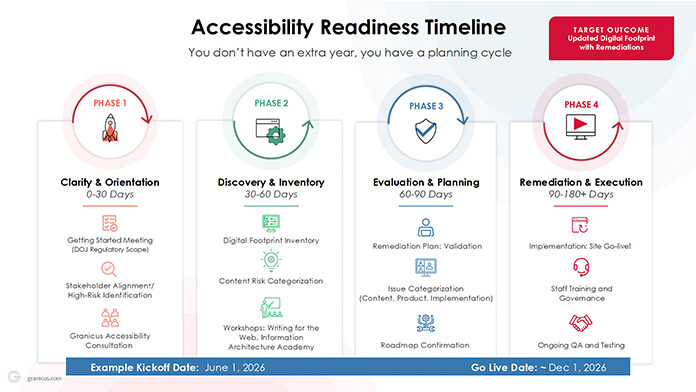
One of the most encouraging things I can share is that agencies do not jump from reactive accessibility efforts to continuous conformance overnight.
Progress is typically incremental.
Organizations start by understanding their digital footprint. They identify risks. They establish ownership. They create governance structures. They document standards. They provide training. They improve workflows. And over time, accessibility becomes less mysterious and more operational.
Technology can support that work. Audits can support that work. Consultants can support that work. Vendors can support that work.
But sustainable accessibility ultimately depends on building organizational understanding of what accessibility is, who it serves, and why it matters. When teams understand the end users behind accessibility requirements and the role accessibility plays in delivering equitable public services, decision-making becomes easier, ownership becomes clearer, and progress becomes more sustainable.
Accessibility has always been about people. The agencies that continue making progress are the ones building systems that help those people stay at the center of their work every day.
Learn more about building an ongoing accessibility conformance program.