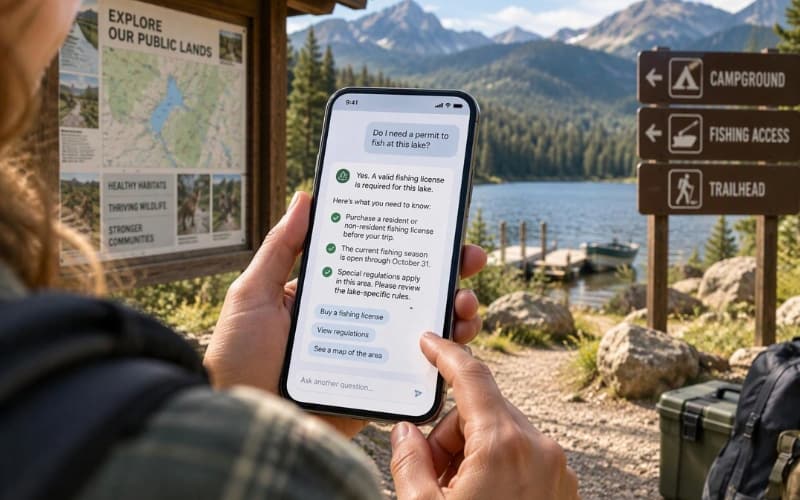
Spending a day outdoors sometimes starts with the surprisingly complicated question of, “Do I need a permit for that?” The answer often requires navigating a maze of agency websites, regulations, maps, fees, and jurisdiction-specific requirements to complete simple tasks like:
- Buying a fishing license
- Reserving a campsite
- Understanding hunting regulations
- Reporting wildlife sightings
- Accessing public land
- Learning about seasonal restrictions
In most cases, state fish and wildlife agencies have already published everything residents need to know; the challenge is landing on the right page with the right information at the right time. What should be a straightforward search can quickly become an information scavenger hunt — and as interest in outdoor recreation continues to grow, so does the need for a seamless online user experience.
Outdoor recreation is one of the most common ways residents interact with the state government. According to the U.S. Fish and Wildlife Service’s 2022 National Survey of Fishing, Hunting, and Wildlife-Associated Recreation, 148 million Americans participated in wildlife watching, 40 million went fishing, and 14.4 million hunted during the year. Together, they took more than 1.7 billion trips and spent an estimated $394 billion on equipment, travel, licenses, and fees.
The economic impact at hand is significant as well. The Bureau of Economic Analysis estimates that outdoor recreation contributed nearly $697 billion to the U.S. economy in 2024, accounting for approximately 2.4% of national GDP.
The unique challenge for fish and wildlife agencies
In such a tech-forward time, residents expect information to be readily available wherever they are. Yet many agencies are responsible for thousands of pages of regulations, seasonal updates, licensing information, conservation programs, public land guidance, and educational resources — to name a few. Keeping that information accurate and accessible while managing limited staff resources is no small task.
Previously, agencies have addressed this challenge by publishing more content. When questions arose, new webpages were added and additional FAQs were created. However, we’ve come to learn that more content doesn’t necessarily make the experience easier.
In fact, as information grows, residents often struggle even more to find what applies to their specific situation. A person shouldn’t need to know which division manages fishing licenses to learn how to purchase one or search multiple websites to understand hunting regulations for a specific area. They also shouldn’t need to interpret complex policy language to determine whether a permit is even required.
That’s why many agencies are beginning to rethink how people discover and interact with government information. Rather than forcing residents to navigate agency structures, the goal is increasingly to help residents clearly describe what they need and receive a definitive answer.
This is where conversational artificial intelligence (AI) can play an important role.
The convenience of conversational AI
When grounded in agency-approved content, AI can help residents ask questions in plain language and receive clear guidance based on trusted information. Someone could ask what regulations apply in a specific area or what steps are needed before a trip — and instead of searching through multiple pages, they receive a direct path to the information and action plan they need.
Reducing repetitive inquiries allows staff to focus on higher-value activities like conservation, stewardship, education, and enforcement. It helps agencies serve more residents without requiring them to navigate increasingly complex digital ecosystems. And perhaps most importantly — it helps connect people with the resources, programs, and outdoor experiences their agencies work hard to protect.
The future of wildlife and outdoor recreation services depends on ensuring residents can easily enjoy them. No matter what resources your residents are searching for, the Government Experience Agent (GXA) helps deliver trusted answers and guided support through simple, conversational experiences.