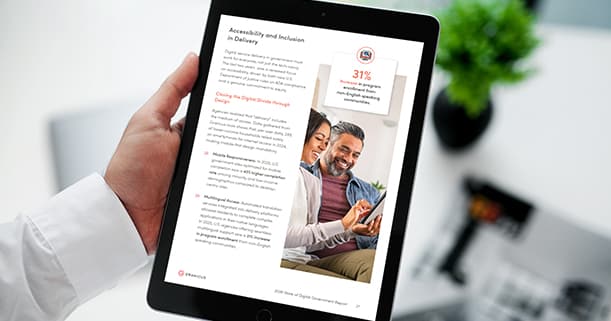
Public sector leaders need clear benchmarks to navigate digital transformation with confidence.
The 2026 State of Digital Government report provides those benchmarks, combining survey data, platform signals, and subject matter expertise to show how governments across North America are building resilient, resident‑focused digital operations.
Rather than relying on anecdote or surface trends, the report grounds strategy in evidence. It connects real operational data to practical decisions about audience reach, service delivery, and trust so agencies can move forward with clarity.
The 2026 State of Digital Government report offers a subject matter expert-driven resource for meeting these challenges. It provides actionable insights and benchmarks to guide agencies through these evolving dynamics based on direct feedback from government leaders and organizations both through their use of Granicus tools and survey data that reflects their current day-to-day concerns.
This intricate balancing act defines the work of the modern public servant. With so many variables, where do local leaders, CIOs, program managers, and digital specialists begin? How can anyone make sense of such complex dynamics and steer confidently toward a brighter digital future for residents and staff alike? The answer, as always, begins with understanding, grounded not just in anecdote, but strengthened with data.
The 2026 State of Digital Government report, as well as the accompanying segment-specific benchmark series, demystifies these shifting realities by moving beyond surface trends. Survey insights gathered in conjunction with ath Power Consulting (APC), platform benchmarks, and findings from approximately 30 billion annual digital interactions across the Granicus platform inform each section of this report. Granicus’ four-part framework of “Grow, Know, Deliver, and Measure” contextualizes a wealth of data into practical, human-centered action. Each phase represents a critical stage, guiding agencies from identifying and understanding audiences to building organizational capacity, delivering high-quality service, and tracking impact with transparency and accountability.
Aimed at North American public sector professionals, these reports bridge strategic objectives with practical actions. Each section provides not only a synthesis of data, but also a guide designed to help transform government operations and outcomes for all residents.
Grow: Expanding audience reach with intention
Effective digital government starts with reach. Before services can improve or trust can deepen, agencies must reliably connect with the people they serve across the channels residents already use.
The 2026 findings show that audience growth is no longer defined by scale alone. It depends on whether messages reach the intended audiences, whether information arrives in the right place at the right time, and whether content is clear and relevant. Agencies that grow reach deliberately focus on coverage gaps, channel effectiveness, and message clarity rather than sheer volume of outreach.
Survey data reflects this shift. Government teams increasingly prioritize strategies that expand reach without fragmenting communications. Clearer content structures, coordinated use of channels, and consistent messaging across platforms help agencies reach broader audiences while reducing confusion and missed connections. When outreach is intentional, fewer residents need to search repeatedly for information or rely on indirect channels to get answers.
Technology plays a supporting role in this evolution. According to the 2026 survey, 71% of respondents report using artificial intelligence in some capacity, and 44% have formal AI policies in place. This adoption signals a growing focus on using technology to support consistent, scalable outreach rather than one off experimentation.
In practice, agencies apply these tools to improve how information reaches the public. AI is increasingly used to support content drafting, optimize distribution across channels, and identify accessibility issues that limit reach. Governance frameworks ensure these tools reinforce public service standards while maintaining clarity and accountability in how messages are delivered.
Growth, in this context, is not about increasing workload or output. It is about ensuring the right people receive the right information more reliably and through their preferred channel. Agencies that expand reach with intention create a stronger foundation for engagement, service delivery, and trust by meeting residents where they already are.
Know: Grounding strategy in real signals
Once an agency has built its audience, the next challenge comes into focus: obtaining a deep understanding of the people it serves. Historically, demographic data provided a starting point for this process. Age brackets, postal codes, and broad interest groups once informed outreach and service design. In 2026, though, that approach no longer goes far enough. Residents move across digital platforms daily, leaving behind behavior trails far richer and more telling than checkboxes on a survey.
Granicus’ 2026 findings highlight the value of unified platforms and tailored experiences as critical strategies for governments seeking to reach distinct audiences and foster lasting trust. We surveyed more than 550 government communications professionals across North America, asking them how they view the current wave of technological change. The response? 68% express optimism about the potential of AI, recognizing that this technology can drive big advances in targeting and consistency. In fact, communicators reported a 15% year-over-year increase in AI use for outreach — a substantial signal that agencies are not just watching the future unfold; they are leaning into it.
But technology alone does not guarantee more effective government. The heart of these findings lies in personalization that truly meets people where they are — an agency’s ability to identify real needs, understand context, and respond in meaningful ways. When a resident signs up for emergency alerts, for example, a unified communications platform allows the agency to deliver alerts via the channel that makes the most sense for that person — whether that is email, text message, or an app. When outreach is tailored and timely, trust grows naturally.
It is no coincidence that these insights are backed by approximately 30 billion digital interactions tracked annually. The sheer scale ensures that patterns are neither flukes nor temporary blips. Instead, these data points reveal a durable trend: digital demand is rising fast in North America. According to the 2026 findings, digital interactions jumped by 25% year over year. This surge creates urgency for government professionals. Residents expect proactive engagement, quick responses, and authentic two-way dialogues. Agencies that meet these evolving expectations position themselves as modern, responsive, and essential to their communities.
Deliver: Creating seamless experiences
Ultimately, residents want results. They want government services that work, without unnecessary barriers or frustration. Most residents do not see the internal divisions, the department lines, or organizational charts. Instead, they experience a single agency and judge it by how easy and effective the service feels from their end.
The 2026 data points to encouraging shifts in delivery. Between 2024 and 2025, form responses in North America increased by 30%. That kind of growth challenges agencies to maintain quality while scaling up. To keep pace, 64% of government call centers now operate as consolidated service hubs. This consolidation eliminates duplication, cuts down on confusion, and enables smarter case management across channels.
The adoption of advanced technology continues to gain ground. Today, 55% of responding organizations already use AI in their digital service workflows. Looking ahead, 78% of local governments plan to expand AI use in the coming year, with hopes of making processes faster, friendlier, and more efficient.
Residents experience government as a single system, not a collection of departments. The Deliver findings reinforce that service quality depends on continuity across channels and workflows.
The 2026 data shows significant growth in digital service use across North America, increasing pressure on agencies to maintain quality at scale. In response, many organizations are consolidating service operations and standardizing workflows to reduce duplication and improve case visibility.
Delivery improves when platforms work together. When forms, contact centers, internal routing, and notifications operate as one system, residents move smoothly between channels, and agencies maintain clear records and accountability throughout the journey.
These changes are not abstract or intangible. The impact is clear: AI adoption is delivering real-world gains, with agencies reporting an average of 15% improvements in operational efficiency. Consider the daily work of preparing for a city council meeting: A task that once required countless staff hours spent compiling and approving agendas, reviewing attachments, and confirming logistics. Automated agenda management now reduces that workload by up to 87%. The result is a transparent, streamlined operation where staff can devote time to strategic priorities rather than administrative tasks, and residents gain earlier and clearer access to important information.
For any service, the lesson becomes clear that building one continuous journey requires every platform and touchpoint work together. When governments unify contact centers, digital platforms, and internal workflows, residents enjoy a seamless experience. They can start with a call, move to an online form, and receive updates by email or text, never losing momentum or facing repeated information requests. The agency, on the other hand, benefits from clear records, faster handoffs, and consistent communication that builds long-term trust.
Measure: Making trust visible
Measurement has always served as a foundation of public sector leadership. In 2026, expectations around measuring success have evolved far beyond simple counts of emails sent, website visits, or social media engagement. Leaders now need to demonstrate not just activity, but genuine outcomes that reflect community impact.
Measurement defines credibility in modern government. Leaders increasingly need evidence that services work, expectations are met, and trust is earned over time.
The 2026 State of Digital Government findings show a clear shift away from activity metrics alone. Agencies now pair volume measures with outcome indicators such as completion rates, time to resolution, and resident sentiment to understand real impact.
Organizations unlock new ways to gather meaningful feedback and foster lasting public trust when they put unified platforms and personalized experiences at the center of their strategy. Rather than relying solely on activity-based statistics like open rates or web traffic, agencies now complement those with outcome-driven metrics — measuring completion rates, time-to-resolution, and the overall sentiment of residents who interact with their services. This approach yields a more complete and honest understanding of an agency’s true impact.
Signals focused on trust are now providing compelling evidence. Agencies that regularly monitor and respond to AI-derived sentiment scores recorded a 14-point increase in positive sentiment year over year, pointing to real gains in public confidence. When transactional Net Promoter Score (NPS) surveys were introduced to capture feedback after service interactions, average scores rose dramatically from –5 in 2024 to +28 in 2025, revealing a striking increase in residents’ willingness to recommend key services — a critical measure of trust. Municipalities tracking and publishing time-to-resolution metrics for 311 requests found that 19% more residents reported feeling “heard,” underscoring the value of timely, accountable service delivery.
Three essentials now define measurement in the modern public sector: unified platforms, personalized experiences, and deliberate strategies to build and reinforce public trust. Focusing on these pillars helps agencies move beyond volume-based evaluation and align their metrics with the substance and quality of public service. For instance, a housing department might look at more than just how many requests they field; tracking what share is resolved within 48 hours and monitoring resident satisfaction rates tells a deeper, more resonant story about performance and responsiveness.
This multidimensional, narrative-informed measurement approach empowers agencies to produce insights that engage the community and fuel ongoing improvements. By capturing richer data and sharing results transparently, public service teams can create a stronger bond with residents and maintain momentum for positive change.
The path forward
The 2026 State of Digital Government series provides more than observations. It offers a practical reference point for agencies committed to steady, evidence‑based progress.
By stabilizing core channels, consolidating platforms, and investing deliberately in data‑informed decision making, governments create momentum that compounds over time. The benchmarks show that meaningful transformation does not require sweeping change, only disciplined, informed action.
Together, North America’s public agencies can build a secure, transparent, and vital digital future one data-driven step at a time.