SUCCESS STORY | Virginia Department of Motor Vehicles (DMV)
How Virginia DMV uses targeted communications to drive Mobile ID adoption


OVERVIEW
The Virginia DMV set out to drive adoption of its Mobile ID program — an ambitious initiative aimed at driving 1 million app downloads. The team had limited prior email marketing capabilities, so it implemented Granicus’ Communications solution (govDelivery) to transform its ability to connect with constituents. This initiative quickly turned email into the highest-performing channel, reaching citizens at a rate far beyond industry benchmarks thanks to expert-led advanced targeting, A/B testing, and data-driven optimization.
SITUATION
The Virginia DMV needed to rapidly increase awareness and adoption of its Mobile ID program across a broad and diverse statewide audience. “Mobile IDs can be used at TSA, by law enforcement if you get pulled over, across a growing list of retail locations,” explained Mike Pressendo, director of communications and marketing for Virginia DMV. “It works as a digital version of an ID, so we want more people to sign up for it.”
The team faced significant limitations, relying primarily on basic Gmail messages that lacked analytics and targeting capabilities. “Our audience is quite broad, as it’s basically everyone 18 and older in the state of Virginia,” explained Pressendo. “We were only getting maybe 500 signups a day, but our goal was to reach 900,000 signups.”
The DMV also needed to communicate different value propositions depending on geography — including travel, retail, and law enforcement applications — making a one-size-fits-all approach ineffective. Individuals risked missing important alerts regarding the adoption or use of their mobile IDs if messages were sent in bulk without specific targeting. Tailoring emails per audience helped eliminate the frustration, disengagement, and loss of trust citizens feel from receiving notifications that don’t pertain to them.
SOLUTION
Virginia DMV used Granicus’ Communications solution to build a data-driven email program designed to maximize relevance and performance. The team leveraged an initial dataset of approximately 2.4 million opted-in residents and applied geo-targeting to ensure constituents received messages tailored to their location.
Continuous experimentation was a vital part of the strategy. The DMV implemented A/B testing across nearly every campaign element, including:
The DMV also adopted a structured resend strategy, targeting non-openers within three to five days to capture additional reach without increasing perceived spam. Messaging was intentionally concise, mobile-friendly, and designed to deliver value immediately so recipients quickly understood the benefit of Mobile ID. Campaigns were aligned with real-world events like travel seasons and holidays, and messaging that emphasized specific use cases — such as relevant TSA checkpoints or retail verification.
📈 TREND WATCH: Better targeting drives stronger outcomes
Segmentation is increasingly tied to measurable program results, as evidenced by data in the 2026 State of Digital Government Report. Yet, connecting with segmented audiences was the top challenge cited by 57% of surveyed government communicators.
- Digitally mature agencies with large, segmented audiences report 2-3x higher adoption rates than less-connected peers.
- Dynamic segmentation drives 27% higher opt-in rates for new programs compared to broadcast-only campaigns.
RESULTS
Email quickly became the DMV’s highest-performing acquisition channel, driving significant spikes in Mobile ID adoption with each campaign. Daily registrations surged from a baseline of roughly 500 to as many as 7,000 to 10,000 following email sends. Open rates have exceeded 80% on top-performing sends — including sends to large audiences over 600,000 — far surpassing typical government benchmarks.
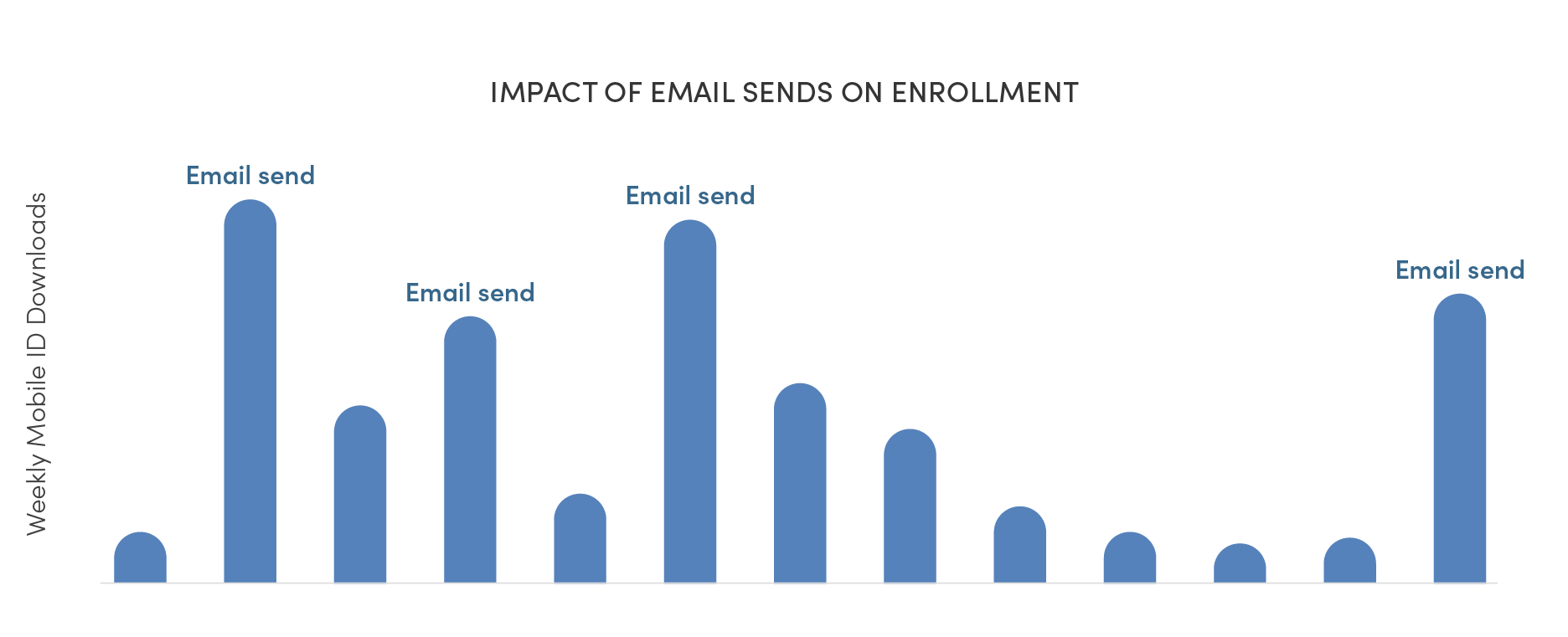
“We’ve never seen these kinds of results before,” said Pressendo. The DMV can now visually correlate adoption spikes directly to email campaigns. As a result, email has become a foundational component of their broader digital strategy, not only for Mobile ID adoption but also for improving customer experience across other services. The team is now expanding its use of Communications to reduce in-office traffic, encourage digital self-service, and deliver timely, personalized alerts tied to key life events like renewals and birthdays.
“The team’s commitment to testing and segmenting has yielded phenomenal results, especially for such large sends,” said Fleur Jarman, implementation lead for Granicus. “An open rate over 60% is already exceptional when targeting over a half million recipients, let alone over 80%.”
📈 DATA INSIGHT:
The median open rate for the top-performing transportation and transit agencies in 2025 was 41%.
Source: Trends in Public Communications Report
Another notable result is the staff time and bandwidth saved. “A lot of what is automated now, the admin staff would have spent two days working on in the old system,” stated Pressendo. This success has elevated email from a supplemental channel to a strategic priority within the DMV, securing the organization’s long-term investment in digital communications.
Granicus’ Communications (govDelivery) email and SMS messaging platform is the premier choice for government digital communications, audience growth, and program awareness strategy. Now powered by AWS, Communications customers get the added advantage of Amazon’s Pinpoint to improve audience segmentation and targeting, ensuring the right messages reach the right users at the right time. The power and flexibility of Granicus Communications combined with AWS’s Simple Email Service (SES) ensure campaigns can scale to reach every constituent, while Amazon CloudWatch provides the metrics to identify successes, trends, and gaps.