After studying thousands of change efforts across industries, researchers at Prosci identified the critical insight that organizational change only succeeds when individuals successfully change alongside it.
That epiphany led to the creation of the ADKAR model, a people-centered framework designed to guide individuals through change in a structured, repeatable way. Rather than focusing on project plans or technical milestones, ADKAR focuses on the outcomes each person must achieve for change to stick. Over time, the model has become one of the most widely used and research-backed approaches to change management across the public and private sectors.
This distinction is especially important for local governments. Agencies routinely introduce new technologies, update policies, and modernize service delivery — but adoption often lags. Staff might understand what is changing without fully grasping why, or they might receive training without the confidence or support to apply it. ADKAR provides a roadmap for addressing those gaps, ensuring new initiatives move beyond implementation and result in sustained behavior change.
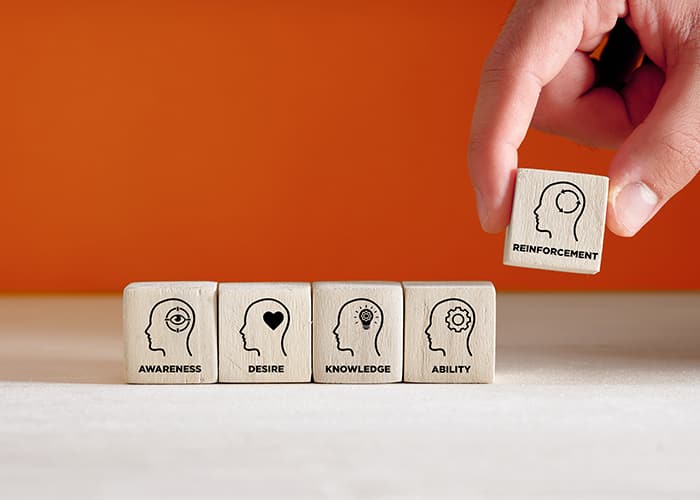
By breaking change down into five measurable outcomes — Awareness, Desire, Knowledge, Ability, and Reinforcement — the ADKAR model gives government leaders a practical way to diagnose resistance, support staff through transitions, and improve the return on technology investments. It is not about forcing change but about guiding people through it in the order they actually experience it.
This guide explores the five steps of the ADKAR model and the critical rules governing its success, showing how you can leverage change to create meaningful opportunities for your community.
The human side of change
To better understand resistance — particularly why staff might cling to manual workflows or hesitate to adopt new digital tools — it is crucial to recognize the step-by-step process each individual must go through to experience success. Change does not happen just because a contract is signed or a new software license is purchased. It happens when individuals alter their behaviors and mindsets.
Prosci’s ADKAR model is a powerful framework for managing this process. It shifts the focus from the technical implementation to the people who drive your mission forward. By addressing both logical and emotional needs, you can guide your teams toward digital transformation with confidence.
The five steps of the ADKAR model
The ADKAR model consists of five distinct outcomes an individual needs to achieve for a change to be successful: Awareness, Desire, Knowledge, Ability, and Reinforcement. Let’s break down each component and see how they apply in a government setting.
1. Awareness
Build understanding about why the change is necessary.
The journey begins with Awareness. You must create and communicate a clear, compelling case for change. In a local government context, this is not just about announcing a new tool; it is about explaining the “why.”
The case must speak to both logical and emotional reasons. Why is this change necessary now? What are the consequences of not changing? For example, if you are moving from paper-based agenda management to a digital solution, the logical case might be cost savings and efficiency. The emotional case could be reducing the stress of late-night packet preparation for your clerks. Without this foundational awareness, staff might view new initiatives as “just another project” rather than a vital evolution.
2. Desire
Build motivation for people to participate in and support the change.
Once people are aware of the need for change, they face a choice: support it or resist it. The goal of this step is to foster a genuine desire to participate. This is often the most significant hurdle in the public sector, where “this is how we’ve always done it” can be a powerful mindset.
Staff will typically either pledge support or adopt a “wait and see” attitude. Occasionally, individuals might actively sabotage a change if they feel threatened. Leaders must address “what’s in it for me?” (WIIFM) for every role. Does this new system automate repetitive tasks? Does it allow staff to focus on more high-value work serving residents? Creating desire requires active listening and addressing fears head-on.
3. Knowledge
Learn what is needed to bring the change to life.
Once people choose to support the change, they must acquire the skills to implement it. This is the training phase. Individuals begin the process of gaining new information or building a knowledge base to support the new ways of working.
For a government agency adopting Operations Cloud, this means specific training on the software. However, knowledge is not just about which buttons to click; it’s about understanding the new processes and behaviors the change requires. Effective training should be timely and specific to each user’s role.
4. Ability
Create opportunities to apply what has been learned.
Knowledge is theoretical; ability is practical. Knowing how to do something does not always mean a person can do it proficiently right away. People need the opportunity to apply what they have learned in a real-world context.
To bridge the gap between knowledge and ability, organizations must create safe spaces for individuals and teams to practice new skills and fail safely. This enables them to build competency and become proficient without the fear of repercussions. In a government setting, this might look like a “sandbox” environment for a new permitting system where staff can practice processing requests before the system goes live to the public.
5. Reinforcement
Sustain the change and prevent sliding back.
The final stage is perhaps the most difficult: sustaining the change. When pressures mount, budgets tighten, or workloads increase, the natural human tendency is to slide back into old ways of working.
Anchoring the new way of working enables an individual — and the organization — to fully realize the benefits of the change. To ensure reinforcement:
- Update performance metrics to align with new goals.
- Create peer support networks or “champions”.
- Implement regular check-ins to address ongoing challenges.
- Celebrate short-term wins to keep morale high.
The rules governing the roadmap
While having the model is helpful, understanding how individuals move through this process is just as important. Misinterpreting the flow of ADKAR can cause your initiative to stall. Here are the critical rules that govern the model:
- The sequence matters: Individuals follow the steps in sequence. You cannot jump straight to training (Knowledge) if your staff does not yet understand why the change is happening (Awareness) or have the motivation to do it (Desire). This is a common pitfall in government tech rollouts.
- Individuals can get stuck: It is possible for someone to stall at any step. A clerk might have Awareness but lack Desire. An IT director might have Knowledge but lack the resources (Ability) to execute.
- Sliding backwards is possible: Without Reinforcement, an individual who reached Ability can regress if the old ways are easier or if leadership loses focus.
- Individuals move through the process at different rates: When faced with a change, some team members will be early adopters, moving quickly through Awareness and Desire. Others will need more time.
Understanding these rules is vital. If leaders assume everyone begins moving through the change process at the same time, they might cease efforts to build awareness too early. As a result, people impacted by the change may never fully understand why it is happening. Since that first step is necessary before advancing to Desire, leaders will fail to gain the support needed to bring the change to life.
Partnering for success with Granicus
Change is a constant in government. Effective change management requires a partner who understands the unique landscape of the public sector. With decades of success in the public sector, Granicus is your best partner for managing change in your organization. Whether it’s purchasing a new cloud solution, integrating an AI agent, or shifting how you manage public meetings or record requests, we can help you leverage change to create opportunities and drive toward your goals.
Following the ADKAR model creates a structured approach that addresses both the logical and emotional needs of any individual. It is not about forcing change upon people, but rather guiding them through a process of understanding, acceptance, and embracing a new way of doing things.
Are you ready to transform your government operations and ensure your next technology implementation is a success? Contact us today to learn how Granicus can help you improve tech adoption, deepen usage, and increase the ROI on your investments. Together, we can build a more efficient, transparent, and responsive government