BLOG
Healthier, happier, greener: How Enfield Council created positive change within the community

When it comes to public service, every achievement is an accolade worth celebrating. Indeed, as our UK winners of this year’s Granicus Digital Government Awards show, great things happen when the right people, processes, and technologies come together. That’s why we’re taking a moment to celebrate this year’s honourees across six different categories, exploring not just how they won, but how their work can offer real insight — and even inspiration — for every organisation striving to deliver better outcomes for those they serve.
It’s fitting then, that we begin this series by meeting the Transport, Climate, and Place team at Enfield Council, who took the top spot in this year’s Changemaker category. Rooted in positive outcomes, this is an award given to an individual, team, or project dedicated to solving problems in a unique way, all while delivering the kind of results that make a true difference to their communities. With that thought in mind, let’s explore not just how Enfield won, but what their win means for the residents in this part of London.
By blending ambition and commitment with strategy and principle, the Transport, Climate, and Place team has fundamentally reshaped how its community engages with transport and place projects throughout the Enfield area. Acknowledging the inherent complexity that typically accompanies large-scale pieces of work involving transport and place-shaping, Enfield set themselves apart by deliberately placing certain key principles — namely, transparency, inclusivity, and engagement — at the heart of their efforts to make their community a healthier, greener, and more welcoming place.
But more than this, their unique strategy — a blend of digital tactics and on-the-ground effort — proved to be just the right solution for the challenges facing Enfield. After all, for the team, the goal wasn’t merely to build infrastructure, but to ensure that their community was involved in every phase of the process to create it. As we’ll see, this thought and care has paid off. “Our work has not only strengthened democratic participation but has directly improved outcomes for communities across a large, diverse borough,” the team explained.
While the sheer complexity of this initiative alone was a major challenge, the council’s Transport, Climate, and Place team had three other additional barriers to surmount in order to achieve their goals: participation fatigue among residents, a distrust of digital engagement, and a legacy of siloed projects within Enfield. Further explaining resident sentiment prior to undertaking this initiative — which sought to reshape the area’s transport links and services via community feedback — the team explained that “Some residents are wary of digital engagement or feel engagement with the community is a ‘tick box’ exercise … Further, transport interventions often require statutory consultation, formal objections, and legal processes. This can feel exclusionary for community members and limit constructive conversations.”
The Transport, Climate, and Place team noted within their award entry that, “Historically, community engagement on place and transport projects in Enfield was fragmented with residents being engaged on individual projects through different channels and without a broader context for their understanding.”
The team took a two-pronged approach to addressing these challenges, a tactic that has ultimately helped it to implement projects that serve the entire community while simultaneously overcoming the recognised barriers to resident engagement within Enfield.
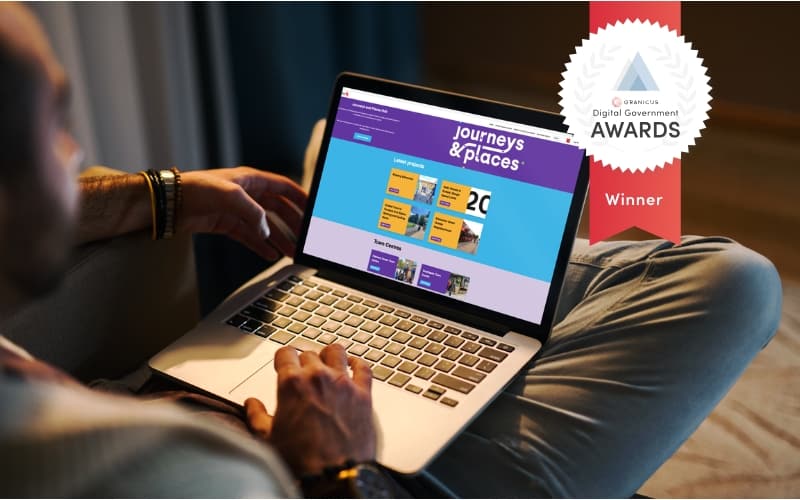
First and foremost, the team turned its Let’s Talk Enfield portal — powered by Granicus’ Sentiment & Feedback solution (EngagementHQ) — into a forum for transparent dialogue. Today, “Every project page hosts a dynamic news feed where updates, decisions, designs, and outcomes are clearly explained. Residents can subscribe for updates, enabling them to stay involved,” the team explains, adding, “This approach builds trust and demonstrates that resident input genuinely shapes outcomes.”
But in addition to this digital strategy, Enfield adds that, “One of our team’s most transformative approaches is our commitment to ‘engaging by doing.’” Rather than relying on static conceptual drawings, the team actively invited residents to experience ideas and opportunities first-hand. For the people of Enfield, this meant taking part in temporary trials, community planting days, urban design pilots, and hands-on activities — like dance workshops, cycle training, guided rides and walks, and visits to a local cycling hub. This thoughtful approach ultimately resulted in deeper, more meaningful feedback, the kind of insight that’s rooted in lived experience and essential in building long-term community ownership.
To complement these efforts, the team now uses a wide range of devices — especially interactive maps where residents can drop pins and share ideas — to foster engagement from the outset of any project. As the team put it, “Our hybrid approach balances digital and face-to-face engagement, recognising that meaningful participation requires both. Alongside online tools, the team delivers community days, drop-in events, workshops, stakeholder meetings, and community panels, ensuring that every resident can be heard.” This final point is extremely relevant, especially given Enfield’s emphasis on equity and inclusion for its residents — particularly those from within its underrepresented communities.
For the team at Enfield, the results of their efforts have been deeply felt and wide-ranging. But above all, they have ensured that active travel is now accessible to all within their community, embedding healthy habits and a healthy future for residents throughout this area of London.
As the team explain,
What’s more, they add that, “Engagement with young people and disabled residents has increased substantially through targeted initiatives. Thousands have taken part in active travel activities, and public feedback has directly influenced the Transport Strategy, Place Shaping Framework, and major public realm designs. The results reflect community priorities while contributing to Enfield’s climate emergency commitments.”
On the back of all of this — by encouraging residents to utilise active forms of travel (i.e., walking, wheeling, cycling) and public transport — the team’s work has helped to support sustainability and environmental goals while building a sense of social cohesion. As they put it, “Through innovation, creativity, vision, and dedication, we have established a new model for inclusive, experiential, and transparent engagement. Our work has empowered communities, improved outcomes, built trust, and delivered tangible change on the ground.”
This vision of change — realised by the team at Enfield in concert with its residents — is certainly something worth celebrating. With that in mind, stay with us as we honour the winner of our Community Engagement category, an accolade that goes to an organisation that has transformed its approach to resident participation, reaping rich rewards from its streamlined approach to consultation and feedback.