BLOG
When every priority feels urgent
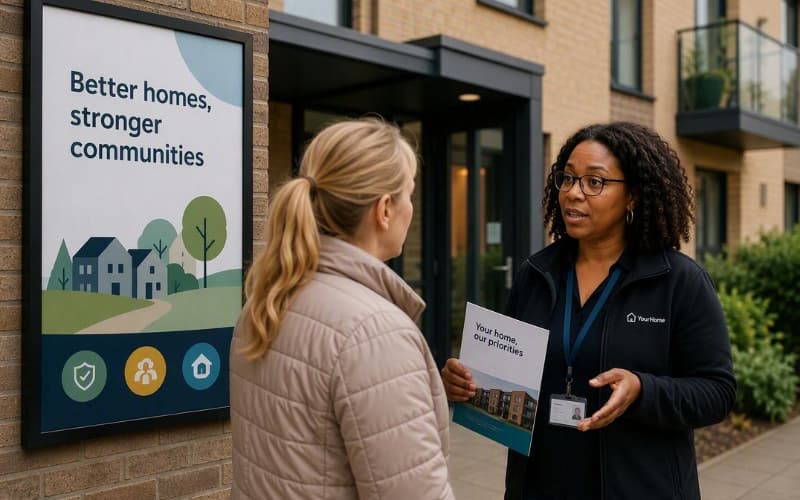

Housing providers are becoming increasingly skilled at setting priorities. The next challenge is helping residents to understand them.
The social housing sector is no stranger to difficult decisions.
Every day, housing providers balance competing priorities: investing in existing homes, improving resident services, meeting regulatory requirements, strengthening safety, maintaining financial resilience, and contributing to the delivery of new homes.
None of these priorities are optional. All of them matter.
Over recent years, much of the sector’s focus has been on getting better at making these decisions. Regulatory reforms, increased scrutiny, and stronger accountability frameworks have all pushed organisations to become more disciplined, evidence-based, and transparent in the way they set priorities. From Consumer Standards and Tenant Satisfaction Measures (TSMs) to Awaab’s Law and the Housing Ombudsman’s Complaint Handling Code, the expectation for stronger governance and accountability has continued to grow.
Housing providers are becoming increasingly skilled at deciding what matters most. The harder question is whether residents understand those decisions.
For many years, the sector’s challenge was capacity. How do organisations identify the biggest risks? Where should investment be focused? How do providers balance safety, service quality, maintenance, development, and resident outcomes?
Those questions have not disappeared. What has changed is the environment in which those decisions are being made.
Residents today have greater visibility of housing issues and greater awareness of their rights. But alongside this, their expectations of transparency are higher than ever before. At the same time, regulatory frameworks continue to place stronger emphasis on accountability, outcomes, resident experience, and organisational learning.
As a result, the challenge is no longer simply deciding what to prioritise. Increasingly, it is helping residents to understand why some priorities move faster than others.
One of the assumptions often made in housing is that dissatisfaction stems from poor decisions. In reality, frustration is frequently caused by a lack of understanding.
Residents do not always see the competing pressures organisations are managing. They might not see the difficult choices being made between investment programmes, compliance obligations, service improvements, and long-term strategic commitments.
From an organisational perspective, those trade-offs may be clear. From a resident perspective, they are often invisible.
This creates an expectation gap — not because residents are asking too much or because organisations are doing too little — but because the reasoning behind decisions is not always visible.
The result is an important lesson for the sector: People are often more willing to accept a difficult decision than they are to accept a decision they do not understand.
Traditionally, transparency has been associated with sharing information: publishing updates, providing notices, making reports available. These practices remain important.
However, the next generation of transparency goes further. It is not just about making information available; it is about making decisions understandable.
Residents increasingly want to understand:
The question is no longer: Have we communicated? The question is: Have we helped residents understand?
Those are not always the same thing.
As expectations continue to rise, one of the most valuable skills organisations can develop is the ability to communicate priorities clearly.
This is particularly important during periods of change.
The social housing sector is entering an era defined by transformation. Government policy continues to focus on housing quality, new supply, safety, and long-term renewal, while the Regulator of Social Housing is engaging the sector on how to deliver more and better social homes while maintaining resilience and accountability.
Against this backdrop, organisations will continue making difficult choices.
Not every project can move first. Not every expectation can be met immediately. Not every priority can be addressed at the same time.
The organisations that maintain confidence will be those that can explain these realities openly, consistently, and credibly.
Trust is often discussed as the outcome of good service. And rightly so. But trust is also built through understanding.
When residents understand why decisions have been made, even difficult decisions become easier to navigate.
When priorities are clearly explained, uncertainty is reduced.
When organisations communicate openly about competing pressures, residents are better equipped to see the broader context.
None of this eliminates disagreement.
The goal is not universal agreement. The goal is confidence that decisions are being made thoughtfully, fairly, and transparently.
That confidence becomes increasingly important in an environment where expectations continue to rise across every area of housing.
Over the past decade, the sector has made significant progress in strengthening accountability, improving governance, and placing residents more firmly at the centre of decision-making.
The next step may be less about setting better priorities and more about explaining them better.
As scrutiny increases and expectations continue to evolve, housing providers have an opportunity to move beyond simply making the right decisions to helping residents understand them.
And in a sector where every priority feels urgent, that ability may become one of the most important trust-building capabilities an organisation can possess.
To help housing teams strengthen communication, transparency, and resident confidence, we’ve created a practical guide focused on building trust through resident engagement.
To help housing teams strengthen communication, transparency, and resident confidence, we’ve created a practical guide focused on building trust through resident engagement.